Convenient Action — Page 19

Original English text

i | |
From Water Riots To Water Security ;
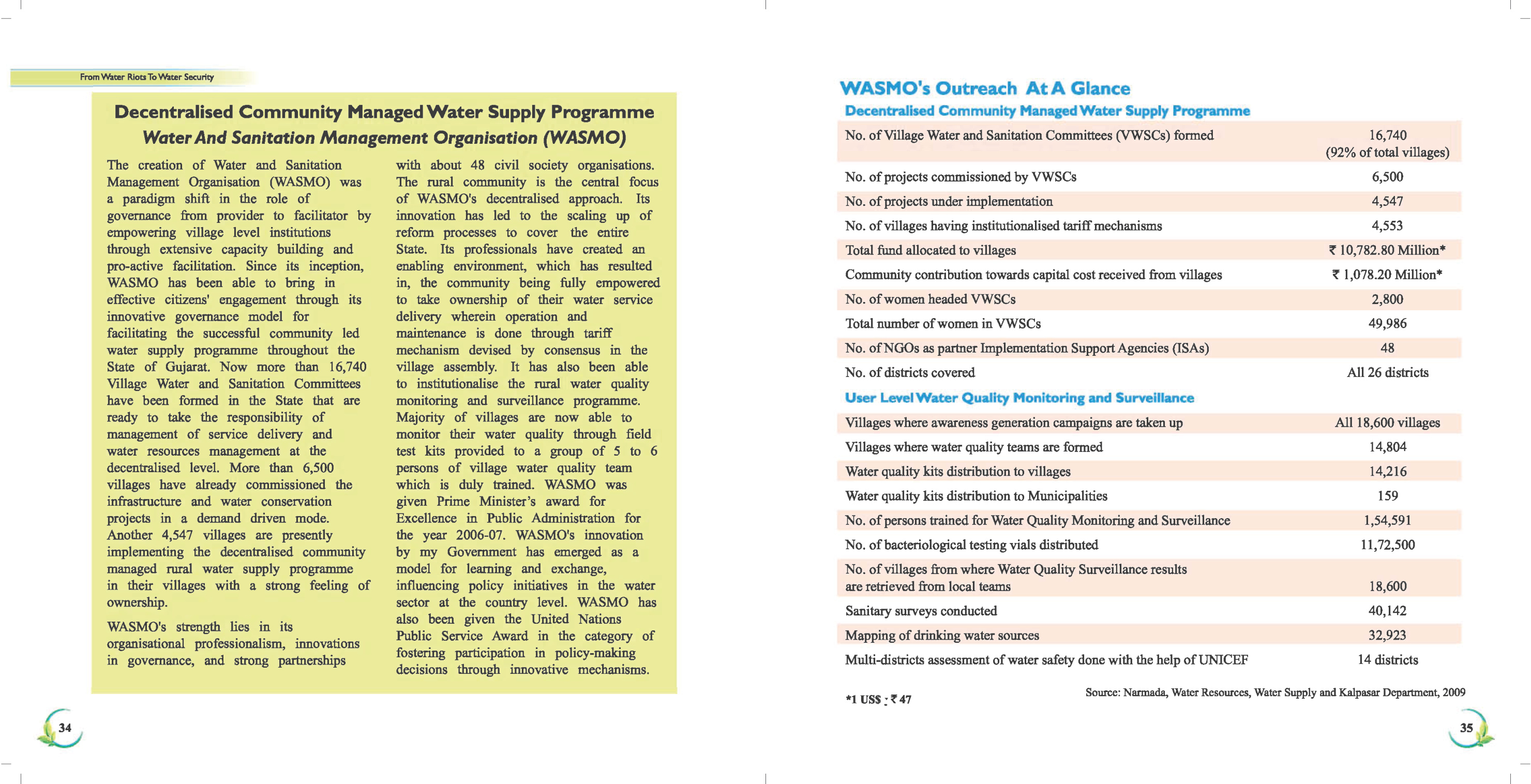
: = WASMO's Outreach At A Glance
Decentralised Community Managed Water Supply Programme Decentralised Community Managed Water Supply Programme
Water And Sanitation Management Organisation (WASMO) No. of Village Water and Sanitation Committees (VWSCs) formed. or Mee i
4 of total villages
The creation of Water and Sanitation with about 48 civil society organisations. . _
Management Organisation (WASMO) was The rural community is the central focus No. of projects commissioned by VWSCs 6,500
a paradigm shift in the role of of WASMO's decentralised approach. Its No. of projects under implementation 4,547
governance from provider to facilitator by innovation has led to the scaling up of . Soe ee . . .
empowering village level institutions teform processes to cover the entire No. of villages having institutionalised tariff mechanisms 4,553
through extensive capacity building and State. Its professionals have created an Total fund allocated to villages = 10,782.80 Million*
pro-active facilitation. Since its inception, enabling environment, which has resulted . os . . . seg
WASMO has been able to bring in in, the community being fully empowered Community contribution towards capital cost received from villages = 1,078.20 Million’
effective citizens’ engagement through its to take ownership of their water service No. of women headed VWSCs 2,800
innovative governance model for delivery wherein operation and Total f in VW: 49.986
facilitating the successful community led maintenance is done through tariff ial nontaberat woutes. i VWs al
water supply programme throughout the mechanism devised by consensus in the No. of NGOs as partner Implementation Support Agencies (ISAs) 48
State of Gujarat. Now more than 16,740 village assembly. It has also been able No. of districts covered All 26 districts
Village Water and Sanitation Committees to institutionalise the rural water quality
have been formed in the State that are monitoring and surveillance programme. User Level Water Quality Monitoring and Surveillance
Teady to take the tesponsibility of Majority of villages Ge Bow able to Villages where awareness generation campaigns are taken up All 18,600 villages
Management of service delivery and monitor their water quality through field .
water resources management at the test kits provided to a group of 5 to 6 Villages where water quality teams are formed 14,804
decentralised level. More than 6,500 persons of village water quality team Water quality kits distribution to villages 14,216
villages have already commissioned the which is duly trained. WASMO was Co oa
infrastructure and water conservation given Prime Minister’s award for Water quality kits distribution to Municipalities 159
projects in a demand driven mode. Excellence in Public Administration for No. of persons trained for Water Quality Monitoring and Surveillance 1,54,591
Another 4,547 villages are presently the year 2006-07. WASMO's innovation 7 —= as
implementing the decentralised community by my Government has emerged as a No. of bacteriological testing vials distributed 11,72,500
managed rural water supply programme model for learning and exchange, No. of villages from where Water Quality Surveillance results
in their villages with a strong feeling of influencing policy initiatives in the water are retrieved from local teams 18,600
ownership. sector at the country level. WASMO has Sanitary surveys conducted 40,142
' ee also been given the United Nations

WASMO's strength lies in its f : . F so

ss Re : : Public Service Award in the category of Mapping of drinking water sources 32,923
organisational professionalism, innovations — een licy-makin:
in governance, and strong partnerships tte bal poor ry ants = hen s. Multi-districts assessment of water safety done with the help of UNICEF 14 districts

*1 USS: 247 Source: Narmada, Water Resources, Water Supply and Kalpasar Department, 2009
f >
\, 34 35)
“aT ee
| | |
English text

i | |
From Water Riots To Water Security ;
: = WASMO's Outreach At A Glance
Decentralised Community Managed Water Supply Programme Decentralised Community Managed Water Supply Programme
Water And Sanitation Management Organisation (WASMO) No. of Village Water and Sanitation Committees (VWSCs) formed. or Mee i
4 of total villages
The creation of Water and Sanitation with about 48 civil society organisations. . _
Management Organisation (WASMO) was The rural community is the central focus No. of projects commissioned by VWSCs 6,500
a paradigm shift in the role of of WASMO's decentralised approach. Its No. of projects under implementation 4,547
governance from provider to facilitator by innovation has led to the scaling up of . Soe ee . . .
empowering village level institutions teform processes to cover the entire No. of villages having institutionalised tariff mechanisms 4,553
through extensive capacity building and State. Its professionals have created an Total fund allocated to villages = 10,782.80 Million*
pro-active facilitation. Since its inception, enabling environment, which has resulted . os . . . seg
WASMO has been able to bring in in, the community being fully empowered Community contribution towards capital cost received from villages = 1,078.20 Million’
effective citizens’ engagement through its to take ownership of their water service No. of women headed VWSCs 2,800
innovative governance model for delivery wherein operation and Total f in VW: 49.986
facilitating the successful community led maintenance is done through tariff ial nontaberat woutes. i VWs al
water supply programme throughout the mechanism devised by consensus in the No. of NGOs as partner Implementation Support Agencies (ISAs) 48
State of Gujarat. Now more than 16,740 village assembly. It has also been able No. of districts covered All 26 districts
Village Water and Sanitation Committees to institutionalise the rural water quality
have been formed in the State that are monitoring and surveillance programme. User Level Water Quality Monitoring and Surveillance
Teady to take the tesponsibility of Majority of villages Ge Bow able to Villages where awareness generation campaigns are taken up All 18,600 villages
Management of service delivery and monitor their water quality through field .
water resources management at the test kits provided to a group of 5 to 6 Villages where water quality teams are formed 14,804
decentralised level. More than 6,500 persons of village water quality team Water quality kits distribution to villages 14,216
villages have already commissioned the which is duly trained. WASMO was Co oa
infrastructure and water conservation given Prime Minister’s award for Water quality kits distribution to Municipalities 159
projects in a demand driven mode. Excellence in Public Administration for No. of persons trained for Water Quality Monitoring and Surveillance 1,54,591
Another 4,547 villages are presently the year 2006-07. WASMO's innovation 7 —= as
implementing the decentralised community by my Government has emerged as a No. of bacteriological testing vials distributed 11,72,500
managed rural water supply programme model for learning and exchange, No. of villages from where Water Quality Surveillance results
in their villages with a strong feeling of influencing policy initiatives in the water are retrieved from local teams 18,600
ownership. sector at the country level. WASMO has Sanitary surveys conducted 40,142
' ee also been given the United Nations

WASMO's strength lies in its f : . F so

ss Re : : Public Service Award in the category of Mapping of drinking water sources 32,923
organisational professionalism, innovations — een licy-makin:
in governance, and strong partnerships tte bal poor ry ants = hen s. Multi-districts assessment of water safety done with the help of UNICEF 14 districts

*1 USS: 247 Source: Narmada, Water Resources, Water Supply and Kalpasar Department, 2009
f >
\, 34 35)
“aT ee
| | |

Scanned page

Click the scan to open the full-size page image.

Scan of page 19